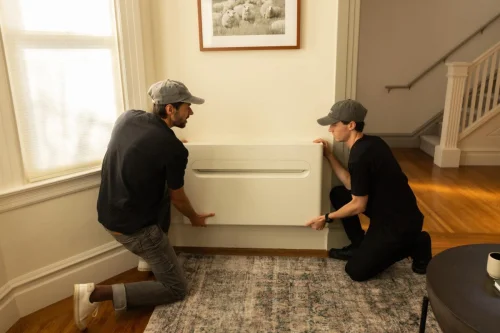
Merino Energy, a startup founded by a former Apple AirPods engineer, has unveiled a new heat pump designed to dramatically reduce the cost and complexity of installation. The Merino Mono, priced at $3,800, integrates all components into a single indoor unit and can be installed in about an hour using a standard household outlet.
The launch comes as California struggles to meet its target of installing 6 million heat pumps by 2030, a goal requiring an average of 2,000 installations per day for the next five years. Current systems can cost between $4,000 and $6,000 per zone and take a day to install, creating a significant barrier to widespread adoption.
A Simpler Solution for a Complex Problem
Mary-Ann Rau, co-founder and CEO of Merino Energy, told TechCrunch that her own experience trying to electrify her San Francisco home led to the company's creation. "I had total sticker shock," she said, referring to the cost of traditional heat pumps. "That’s when I realized that if it was inaccessible for me... it’s out of reach for the vast majority of Californians and Americans."
Unlike conventional systems with separate indoor and outdoor units, the Merino Mono combines the condenser and heat exchanger into one device roughly the size of a window radiator. It plugs into a standard 120-volt outlet, potentially eliminating the need for expensive electrical upgrades. "If you can plug in a microwave and it works on that outlet, then the Merino Mono is gonna work on that outlet," Rau explained.
Trade-offs and Target Market
The simplified design involves a trade-off in efficiency. The Merino Mono has a SEER2 rating of 15.2, lower than the 25 rating of more complex systems like the Quilt two-zone model. Rau acknowledged that large outdoor condensers perform better but argued the Mono's design is "proportional to the problem" for many applications.
The startup is initially targeting smaller living spaces, apartments, and condominiums in dense urban areas. Its first major project is installing 48 units at the Civic Center Apartments, a low-income housing development in Richmond, California.
Smart Features and Future Plans
The Wi-Fi-connected unit includes modern features such as occupancy sensing and the ability for multiple units in a home to coordinate for efficiency. Merino is even developing an integration with Oura Rings to slightly lower the room temperature when the wearer enters REM sleep.
Installation involves cutting two holes in an exterior wall for air intake and exhaust, with only these ports and a condensate pipe visible from outside. This eliminates the need for brazing copper lines and charging refrigerant lines between separate units, a process Rau described as "very expensive from a labor perspective."
The company is currently taking pre-orders for delivery later this year and has signed up six installers in the Bay Area and Los Angeles. While focused on California, Merino Energy plans to expand to other states including Hawaii, Oregon, and Washington.