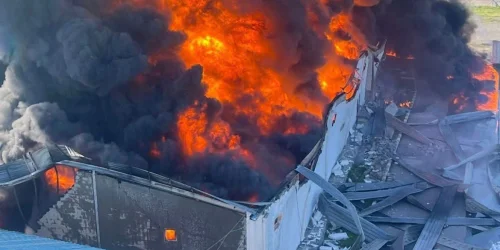
Kurdish security forces in northern Iraq have presented a collection of Iranian drones and missiles used in attacks on the city of Erbil, providing a stark visual catalogue of Tehran's expanding arsenal. The display, shown exclusively to Business Insider, included ballistic missiles, long-range Shahed drones, and a new jet-powered model, highlighting the technological sophistication of the weapons that have killed 17 people in the Kurdistan region since late February.
According to Halmat, a member of the Kurdish bomb-analysis team, Iran has launched more than 400 drones and ballistic missiles at the Erbil region alone. His unit has defused and collected more than 200 explosive devices. The attacks have targeted both civilian areas and military installations, including the US consulate and a military base at Erbil's airport.
A Gallery of Modern Weaponry
In a secured yard in Erbil, the remains of Iranian weaponry were laid out for examination. Central to the display were multiple variants of the Shahed long-range drone, a delta-winged weapon with a range of up to 1,200 miles that Russia also uses extensively in Ukraine. "We identified three kinds of Iranian Shahed drones," Halmat stated, noting differences in colour and finish.
The collection also featured the new Hadid-110, a jet-powered attack drone that can travel at over twice the speed of most Shahed models, making it harder for air defences to intercept. One such drone struck a home in a neighbourhood outside Erbil. The Meraj-532, a medium-range attack drone used by Iran's Revolutionary Guards, was also among the wreckage.
At the back of the yard lay the bulky, 10-meter-long remains of a Kheibar ballistic missile. "They also used it to strike civilian areas here in the region," said Pishtiwan, part of the Asayish security forces' engineering team, pointing to impact markings dated March 19.
An Arsenal Built with Foreign Help
Military analyst Colonel Markus Reisner attributed the potency of Iran's arsenal to decades of development with external support. "With the help of Russia, China and North Korea, Iran has succeeded over recent decades in building up an impressive arsenal of effective, technologically sophisticated long-range weapons," he said.
This capability has allowed Tehran to sustain a high tempo of attacks. "Tehran's ability to continue carrying out 60 to 90 drone attacks a day — combined with missile strikes — even into the sixth week of the war prolonged the conflict," the report noted. Despite thousands of counter-strikes by the US and Israel, US intelligence assessments reported by CNN suggest around half of Iran's missile launchers remain intact, alongside thousands of long-range kamikaze drones.
Reisner warned of the weapons' combined effectiveness: "Drones are being deployed in a saturating combination with cruise missiles and rockets. When these weapons systems are combined with targeted satellite reconnaissance from Russia and China, they also develop a troubling degree of precision."
Western Defences Tested
The conflict has demonstrated the challenges of defending against such saturation attacks, even for advanced militaries. Kurdish security forces stated they are almost entirely dependent on Western air defence systems, including Patriot missiles to counter ballistic threats and C-RAM gun systems to engage drones.
US fighter jets like the F-16 Fighting Falcon were regularly scrambled to hunt drones, and the Raytheon Coyote drone was reportedly used to destroy several in flight. Despite these measures, the attacks proved that "not even the United States — the most advanced military in the world — can fully protect its bases and diplomatic facilities in a modern drone war," the report concluded.
The French military suffered a casualty in March when a drone strike killed a soldier near Erbil, confirmed by President Emmanuel Macron as the country's first military death in the Middle East war.
A Warning for Europe
Colonel Reisner stated the attacks serve as a "final warning for Europe," noting that the range of Iranian missiles extends to the continent's periphery. He emphasised the importance of defence initiatives like the US missile defence system in Europe (EPAA) and Germany's procurement of the Israeli 'Arrow' system.
For the Kurdish bomb-disposal teams, the work remains perilous. Pishtiwan explained that specialists are dispatched after every explosion to assess damage and identify the weapon, with the constant risk of follow-up "double-tap" strikes. "But it is our duty to protect our people," he said. "We are ready to sacrifice our lives for this country."