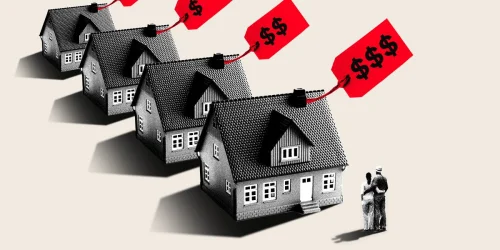
A new analysis reveals that first-time buyers in the United States are facing an unprecedented financial burden, spending a significantly larger portion of their income on housing than established homeowners. The gap, now at a record six percentage points, underscores a profound shift in the property market's affordability landscape over recent years.
According to a study by the bipartisan think tank Economic Innovation Group (EIG), housing costs consumed 26% of the budget for those who purchased a home in the previous 12 months in 2024. This compares to just 20% for longer-tenured homeowners. This six-point disparity is the largest recorded since at least 1990.
The 'New Homeowner Penalty' in Practice
For buyers like Aaron Solomon, 37, and his wife, the reality of this penalty is stark. After searching for over a year, they purchased a four-bedroom home in Morristown, New Jersey, for $1 million in January 2025. Their monthly payments now stand at $6,000, a 50% increase from their previous $4,000 rent. "I'm still like, 'Holy crap, how did we buy a home for a million dollars?'" Solomon told Business Insider.
Jess Remington, a research analyst at EIG, terms this phenomenon the "new homeowner penalty." She states, "That six percentage-point difference really adds up to, practically speaking, a lot of your money." In practical terms, 6% of the median household income equates to over $5,000 annually.
Converging Factors Driving the Crisis
Several key factors have converged to create this disadvantage for new entrants. Nationally, the median sale price has risen roughly 24% since 2019. While prices have cooled in some previously overheated markets like Austin and Phoenix, they remain at or near record highs in the Midwest and Northeast due to persistent supply shortages.
Simultaneously, financing costs have soared. The typical mortgage rate for new buyers jumped from 3% in 2021 to 6.6% in 2024, according to the Urban Institute. Although rates have fluctuated, they recently spiked again to approximately 6.4%. On a $400,000 home with a 20% down payment, a buyer today pays roughly $650 more per month than a buyer in 2021.
The financial barrier to entry has also heightened. Adjusted for inflation, the average down payment grew by 30% from 2019 to 2024, while the average household income grew by less than 1%.
Regional Disparities and Market Realities
The affordability gap is nationwide but most severe in regions with acute housing shortages. Rhode Island exhibits the second-widest gap at 10 percentage points, behind only Hawaii. A 2024 report found a household needs to earn roughly $130,000 annually to affordably buy a typical home in the state—$40,000 above the state's median income.
"That's not a matter of people should work harder... There's limited resources," said Melina Lodge, Executive Director of the Housing Network of Rhode Island. She notes that rising costs for gas, health insurance, and childcare further strain budgets.
Real estate agents report buyers are adapting through compromise. "I see compromising way more than I see stretching," said Steph Mahon, principal agent at Dwell New Jersey. Buyers are searching at lower price points, looking farther afield, or considering fixer-uppers to avoid overextending themselves financially.
Long-Term Outlook and Potential Solutions
Experts see little immediate relief. Mortgage rate drops could stimulate demand and push prices higher, offering limited benefit to new buyers. Proposed property tax cuts would disproportionately aid older homeowners. The consensus among housing researchers is that the primary solution is increasing housing supply in high-demand areas.
Remington points to a nationwide wave of zoning reforms and streamlined permitting as encouraging signs. However, the effects will take time. "It takes a minute for all the cogs in the machine to catch up," Lodge cautioned.
While an influx of supply may moderate future price inflation, it likely means more modest equity gains for today's buyers compared to previous generations. Reflecting on her own 2018 purchase in Rhode Island, which has doubled in value, Lodge acknowledged, "I don't think that same opportunity will exist in the near future."