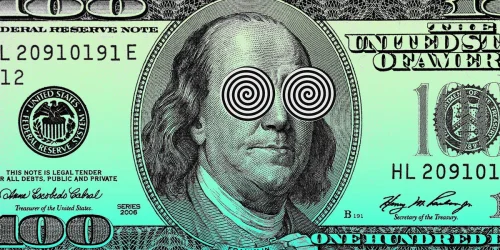
American consumers are accumulating record levels of credit card debt, now standing at $1.28 trillion, as financial products designed to eliminate spending friction make it dangerously easy to overspend. The convergence of stored payment details, one-click purchasing, and the proliferation of buy-now-pay-later (BNPL) plans is creating a "funny money" economy where the true cost of purchases is often obscured until debts become unmanageable.
This shift is underpinned by a stark behavioural reality: the human brain is poorly equipped to resist instant gratification, especially when financial barriers are removed. "The part of our brain that wants what it wants when it wants it is so much stronger than the part of our brain that's a brake system," says Kristina Durante, a social psychologist at Rutgers University.
The Frictionless Spending Trap
The modern shopping experience has been engineered for ease, experts say. The transition from cash to cards, and now to automatically filled digital wallets and services like Apple Pay, has systematically removed moments for consumers to pause and reconsider purchases. "I just want to be a hot knife through butter here. I want to make it as easy and frictionless as humanly possible," explains Scott Rick, a marketing professor at the University of Michigan.
This frictionlessness extends to accessing credit itself. New technology allows for instant credit card approvals, while specialised cards target those with low credit scores or limited histories. The result is a surge in both traditional and alternative debt. A December 2025 Consumer Financial Protection Bureau (CFPB) report found that six major BNPL firms reported 53.6 million consumers took out a loan in 2023, a 12% annual increase.
How 'Funny Money' Obscures Reality
Financial products use psychological tactics to distance spending from the feeling of parting with real money. Credit card rewards and points can feel like "monopoly money," says Ayelet Fishbach, a behaviour science professor at the University of Chicago, obscuring the actual price. BNPL plans exploit mental accounting by breaking large sums into seemingly small, manageable instalments, making consumers feel "less financially constrained," according to Ying Lei Toh, a senior economist at the Kansas City Federal Reserve.
The average BNPL loan amount rose to $848 in 2023, up from $725 the previous year. For providers, these plans can be profitable through interest and late fees, while also reaching demographics that avoid traditional credit.
Personal Debt Spiral
For individuals, the consequences are severe and personal. Mirav Steckel, 21, accumulated debt across 15 credit cards driven by impulse purchases, forcing her to adopt a cash-only budget to regain control. Stephanie Blanks, 35, found herself with $3,700 in BNPL debt after using the plans for essentials like nappies and groceries following the birth of her child. "You're drowning in them," she says.
While some, like Gabby Raines, 29, have used BNPL responsibly for major purchases like a mattress, she acknowledges the ease still leads to unintended overspending. For others, like 73-year-old Susan Cannon, credit became a means of survival during job loss, leaving her nearly $40,000 in debt with crippling interest. "I cannot get ahead," she states.
Broader Economic and Social Impact
The trend has significant macroeconomic and social ramifications. High debt loads can slow economic growth as consumers divert income to repayments. Bankruptcy filings increased 11% in 2025. Social media exacerbates the issue, enabling constant comparison with curated lifestyles worldwide and spawning trends like "girl math," which uses mental gymnastics to justify spending.
Abigail Sussman, a marketing professor at the University of Chicago, notes that a "keeping-up-with-the-Joneses" culture is aggravated when neighbours see only consumption, not the debt behind it. With economic uncertainty and high inflation, consumers may feel pressured to buy now, assuming prices or tariffs will rise later, further entrenching the cycle.
Experts conclude that the system itself is the primary issue. "We created a system that makes it very hard to make good financial decisions," says Fishbach. As these frictionless mechanisms become further embedded in commerce, the challenge for consumers to navigate the "funny money" economy will only intensify.