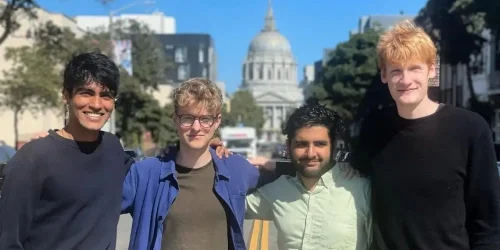
Imagine telling your mates at uni that in a few years, you'd be negotiating a deal worth up to $60 billion with the world's richest man. For the four twenty-something MIT graduates behind Cursor, that fantasy is now a staggering reality. This isn't just another tech acquisition; it's a seismic power play that puts one of Silicon Valley's youngest teams at the heart of Elon Musk's empire. The question is, why would SpaceX bet the farm on a coding tool?
The answer lies in a desperate race for AI supremacy. On Tuesday, SpaceX announced a deal granting it the right to acquire the AI coding startup for a colossal $60 billion. If it doesn't buy Cursor outright, it must pay $10 billion just for its work. This move isn't about rockets; it's about code. It gives Musk's company, which already owns the AI assistant Grok, a direct contender against giants like OpenAI's Codex and the rising threat of Anthropic's Claude Code.
The "Crazy Recruiting Stunts" That Built a $29 Billion Unicorn
Cursor's journey from dorm-room dream to tech titan reads like a Silicon Valley thriller. Founded by Michael Truell, Sualeh Asif, Arvid Lunnemark, and Aman Sanger, they were driven by a simple frustration: AI was getting smarter, but tools like GitHub Copilot felt stagnant. "It was like, 'Man, the ceiling is getting higher, why are they not making new things?'" cofounder Asif recalled. They didn't want a chat window bolted onto an old editor; they wanted AI woven into the very fabric of coding.
To build their vision, they pulled off what CEO Truell calls "crazy recruiting stunts," including flying across the world to re-pitch candidates who had already said no. The gamble paid off. From an $8 million seed round led by OpenAI's own investment fund in 2023, Cursor's valuation skyrocketed to $29.3 billion by late 2025, backed by the likes of Andreessen Horowitz and Nvidia.
Why Nvidia's CEO Wears Their Logo on His Jacket
Cursor's explosive growth is validated by a client list that's a who's who of tech royalty: Stripe, Coinbase, Discord, and even Amazon, whose employees reportedly demanded the tool. But its most powerful advocate is Nvidia CEO Jensen Huang. In a stunning endorsement, Huang revealed that 100% of Nvidia's engineers and chip designers use Cursor. "Productivity gains, the work that we do is so much better," he stated, later appearing at a conference with a giant Cursor logo emblazoned on the back of his signature leather jacket.
The "Wake-Up Call" That Forced a Reinvention
Yet, the path hasn't been smooth. Earlier this year, the release of Anthropic's powerful Claude Code model triggered a wave of defections. Developers on X proclaimed that using Claude Code was like "getting in a rocket" compared to Cursor's car. Prominent venture capitalist Chamath Palihapitiya called Cursor one of his "biggest AI costs" and declared, "We need to migrate off."
This pressure has sparked a frantic evolution. Just this month, Cursor launched "Cursor 3," a push into autonomous AI agents that can complete tasks independently. More crucially, the deal with SpaceX provides the ultimate lifeline: access to Colossus, SpaceX's monstrous supercomputer powered by 200,000 Nvidia GPUs. "The combination of Cursor's leading product... with SpaceX's million H100 equivalent Colossus... will allow us to build the world's most useful models," SpaceX declared.
What This $60 Billion Deal Means for Every Coder
This partnership is more than a financial transaction; it's a glimpse into the future of work. For software engineers, it signals an accelerated shift from writing code line-by-line to orchestrating AI agents. The collaboration promises models of unprecedented power, potentially making today's coding practices look archaic. For Musk, it's a strategic masterstroke, vertically integrating AI development talent and a beloved product directly into his sprawling tech and space conglomerate. The race to automate innovation itself has just entered hyperspace, and the starting gun was a contract worth more than the GDP of small nations.