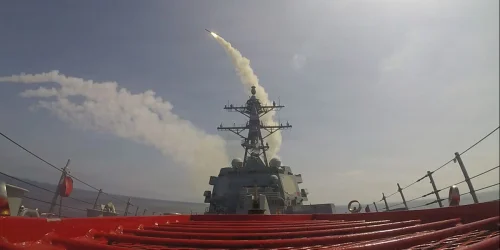
Imagine a world where the United States, the world's military superpower, finds its arsenal alarmingly bare. Not in a decade, but right now. A new, exclusive analysis has uncovered a chilling reality: the recent war with Iran has drained America's reserves of the very weapons it would desperately need to face a far greater threat.
For 39 days, the US unleashed a relentless air and missile campaign. While effective, this offensive has come at a hidden, and potentially catastrophic, cost. Defence experts are now sounding the alarm that this depletion has left a dangerous gap in America's defences, one that could decide the outcome of a future war in the Pacific.
The Seven Missiles That Could Decide America's Future
The report from the Center for Strategic and International Studies (CSIS) zeroes in on seven critical munitions. These aren't just any weapons; they are the **long-range strike and air defence missiles essential for countering a peer adversary like China**. The findings are stark: the US may have already expended more than half of its pre-war stockpiles for four of these key systems.
On defence, the numbers are startling. The US entered the conflict with around 360 high-tech THAAD interceptors. Researchers estimate it used between 190 and 290. For the ubiquitous Patriot system, the US started with about 2,330 PAC-3 interceptors and may have used up to 1,430. "Even before the Iran war, stockpiles were deemed insufficient for a peer competitor fight," the CSIS experts state. "That shortfall is now even more acute."
Why Replacing Them Takes Years, Not Months
Here's the part that should send a shiver down your spine: rebuilding what was lost will take years. Based on current production rates, it could take over four years to replace stocks of missiles like the JASSM cruise missile. For THAAD interceptors, the estimate is 53 months.
"Many of these systems are constrained by production capacity, so manufacturing lead time is even longer," the report warns. While manufacturers like Lockheed Martin and RTX have announced plans to dramatically increase production, this expansion relies on new funding and will take the better part of a decade to fully realise.
In the meantime, the US faces brutal choices. Every missile sent to replenish its own stocks is one not sent to allies like Ukraine, who are already warning of critical shortages. "The United States will compete with those countries that also want to replenish and expand inventories," the researchers conclude.
The Looming Shadow in the Pacific
This isn't just a logistics problem. It's a strategic nightmare. The report makes it brutally clear: "These missiles will also be critical for a potential Western Pacific conflict." A war with China would demand these very munitions in vast numbers—to overwhelm Chinese defences and to counter its own massive missile arsenal.
Worryingly, experts assess that a high-intensity fight with China could burn through US munitions even faster than the war with Iran did. "The levels today will constrain US operations should a future conflict arise," the CSIS report states plainly. The US can shift assets back to the Pacific, but "restoring depleted stockpiles... will take many years."
The message from defence analysts is no longer a whispered concern but a clear warning. America's military edge, long taken for granted, has been visibly eroded in a matter of weeks. The clock is now ticking to rebuild an arsenal for a threat that hasn't gone away—it's only grown larger on the horizon.