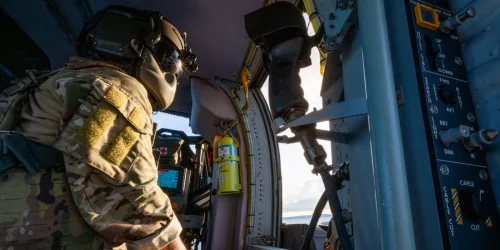
The US military has conducted perilous combat search-and-rescue (CSAR) missions into Iran to retrieve downed aircrew, reinforcing a foundational pledge to recover service members from hostile territory. These operations, which risked multiple aircraft and personnel, highlight the profound institutional and strategic importance the US places on personnel recovery, a principle central to military morale and operational resolve.
President Donald Trump acknowledged the danger, stating the missions "could have ended up with a hundred dead as opposed to one or two," but emphasised the non-negotiable ethos: "we leave no American behind." In the recent incidents, all personnel were successfully recovered.
A Bedrock of Military Morale
This commitment transcends the immediate act of saving lives. According to John Venable, a retired Air Force pilot and senior fellow at the Mitchell Institute for Aerospace Studies, it is the "absolute lifeblood of the fighting force." He argues that the reciprocal belief that the institution will fight to recover its own is a powerful motivator for troops undertaking dangerous missions.
The cultural weight of this promise is symbolised by the black POW/MIA flag, a reminder of service members, particularly from the Vietnam War, who were captured, tortured, and often never returned. Venable notes these experiences are "seared into the US military's institutional and cultural memory."
Evolution from Failure to Doctrine
The professionalisation of modern CSAR tactics has roots in the Vietnam War, where hundreds of recovery missions under fire honed coordination and specialised unit development. A pivotal moment came with the catastrophic failure of Operation Eagle Claw in 1980, a mission to rescue American hostages in Iran that resulted in eight US service member deaths and two destroyed aircraft.
This failure acted as a catalyst, exposing critical joint-service communication failures and contributing to the eventual creation of US Special Operations Command. It reinforced the military's focus on integrated joint operations and refined its approach to high-risk personnel recovery.
Strategic Signals and Operational Imperatives
The demonstrated willingness to attempt such rescues serves as a powerful strategic deterrent. "The message," Venable explains, "is that 'if you think it's going to be easy to capture one of our airmen, you're wrong.'" This commitment complicates an adversary's calculations and protects sensitive intelligence.
John Waters, an Air Force veteran and former F-16 demonstration pilot, notes that captured airmen often possess more sensitive intelligence than other troops and can become valuable propaganda tools for an enemy. This adds a critical intelligence-security layer to the recovery imperative.
Operationally, the assurance of recovery steels resolve. "You can ask more of me if I know you value me," Waters said, reflecting on his nearly 1,000 combat flight hours. Knowing leaders will "try everything in their power" to retrieve a downed airman makes service members more willing to accept the inherent risks of their missions.
Future of Rescue in a New Era of Conflict
The future of the Air Force's elite CSAR units, comprising helicopters, cargo aircraft, and pararescuemen, faces uncertainty. As the Pentagon's focus shifts from the Middle East to potential conflict with a near-peer adversary like China, some leaders have questioned the feasibility of such missions in highly contested environments, leading to reduced investment.
Analysts warn a major conflict could produce casualties on a scale not seen in decades, increasing the number of downed aircrew while possibly straining recovery resources. Despite the cost, one CSAR pilot described the mission as a "sacred duty," arguing its strategic importance outweighs the financial burden. Venable contends that if airmen are in harm's way, "we've got to have the ability to go in and pick them up and take them home."