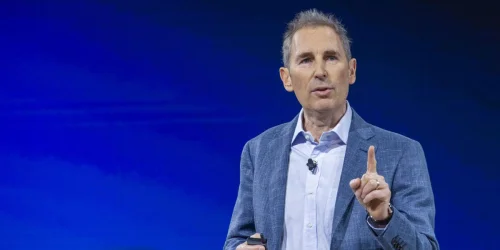
Amazon CEO Andy Jassy has detailed his strategic vision for the company's global workforce of 1.5 million people in his latest annual letter to shareholders. The communication arrives at a critical juncture for the e-commerce and cloud giant, whose stock trades 10% below its November all-time high despite a 26% rise over the past 12 months.
Jassy's letter, which follows two major rounds of layoffs in October 2024 and January 2025 totalling 30,000 jobs, outlines three key principles for the future: the power of small teams, a flatter organisational structure, and a culture comfortable with ambiguity and non-linear progress.
The Power of Tiny Teams
Jassy highlighted the effectiveness of small teams using artificial intelligence to accomplish workloads traditionally requiring many more people. He cited the rapid development and scaling of Amazon Bedrock, a service providing access to third-party large language models like Anthropic's Claude and Meta's Llama.
"This wasn't a tweak; it required a completely different architecture," Jassy wrote about the team's decision to build a new inference engine for Bedrock. The project's success demonstrated how a compact team leveraging AI could execute complex, large-scale technical work.
Commitment to a Flatter Organisation
The Amazon CEO expressed being "pleased" with the flatter organisation's work, a structure pursued following years of rapid growth that he said had created "a lot more people" and "a lot more layers." He argued this complexity threatened to "weaken the ownership" of key employees and slow operations.
During Amazon's third-quarter earnings call in October, Jassy stated his leadership was "committed to operating like the world's largest startup," which entails "removing layers" and "increasing the amount of ownership that people have." He reiterated in the letter that to succeed, "You need to move fast, have teammates that act like true owners, and be scrappy."
Embracing the 'Squiggly Line'
Jassy devoted significant attention to the quality of adaptability, drawing parallels between Amazon's winding business path and his own non-linear career, which included stints in sportscasting, coaching, retail, and investment banking before joining Amazon in May 1997.
"Most long-term endeavours do not follow a linear straight line, up and to the right," Jassy wrote. "Progress jumps around; it'll zig up, then sometimes stall, or zag down, or force you back to the starting line."
He concluded that dealing with change and uncertainty is critical, stating: "You have to have people and a culture that are comfortable operating with ambiguity as you sort through the new normal." He added that market inflections "favour the bold and adaptable."
The letter reinforces Jassy's previous comments on workforce evolution, including a February statement that humans may not be "necessary" for many jobs filled over the past 20-30 years. It sets a clear cultural and operational direction for Amazon's corporate workforce of roughly 350,000 as the company navigates technological shifts and market pressures.