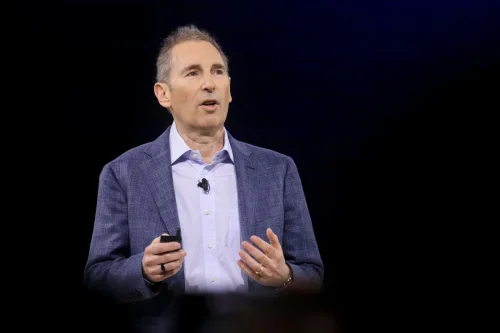
Amazon CEO Andy Jassy has used his annual shareholder letter to position the company's internal technology developments as direct competitors to industry giants like Nvidia and Intel. The letter, published this week, also revealed strong early demand for Amazon's forthcoming satellite internet service and hinted at future commercial robotics ventures.
Jassy framed the strategic moves as a response to customer demand for "better price-performance," justifying Amazon's significant capital expenditure plans. The company has committed to spending approximately $200 billion in 2026, primarily on expanding its AWS data centre infrastructure, a figure that exceeds the planned investments of other major technology firms.
Taking on the Chip Titans
While acknowledging a "strong partnership" with Nvidia, Jassy declared a market shift is underway. He stated that demand for Amazon's proprietary AI training chip, Trainium, is so high that capacity for the upcoming Trainium3 chip is nearly sold out. Remarkably, he reported that capacity for the Trainium4 chip, which is still 18 months away from availability, is also almost fully allocated.
This demand has propelled Trainium to a $20 billion annual revenue run rate. Jassy postulated that if Amazon sold these chips to external customers, that figure would reach $50 billion. For context, Nvidia reported $215.9 billion in revenue last year.
Jassy also targeted Intel, highlighting the adoption of Amazon's Graviton CPU. He noted that 98% of the top 1,000 EC2 customers now use the processor, which competes with Intel's x86 architecture. He revealed that two major companies have requested to "buy all of our Graviton instance capacity in 2026," a demand Amazon could not fulfil due to other client needs.
Expanding Beyond the Cloud
The letter announced progress for Project Kuiper, Amazon's satellite internet constellation set to launch in mid-2026, a competitor to SpaceX's Starlink. Jassy stated the service has already secured contracts with several major entities, including Delta Airlines, AT&T, Vodafone, Australia’s National Broadband Network, and NASA.
In a forward-looking statement, Jassy suggested Amazon could commercialise its robotics expertise. He wrote that data from its 1 million warehouse robots could be used to develop "robotics solutions" for industrial and consumer markets, hinting at a potential future in humanoid robotics.
Justifying the Billions in Spending
A core theme of the letter was defending Amazon's unprecedented capital expenditure. Jassy insisted the investment is not "on a hunch," citing a customer agreement with OpenAI where the AI firm pledged to spend $100 billion on AWS. He acknowledged scepticism around such commitments but claimed several other unannounced customer agreements are in process to purchase AWS capacity.
Addressing concerns of an AI bubble, Jassy wrote, “I’ve followed the public debate on whether this technology is over-hyped, whether we’re in ‘a bubble.’” He concluded that for Amazon, based on tangible customer demand, it is not.
The strategic pivot and spending plans come as Amazon's stock price remains below $200 per share, having not recovered from a recent plunge. Jassy's letter serves as a direct pitch to shareholders, outlining how these investments are intended to secure Amazon's competitive edge in cloud computing, AI, and logistics for the coming decade.