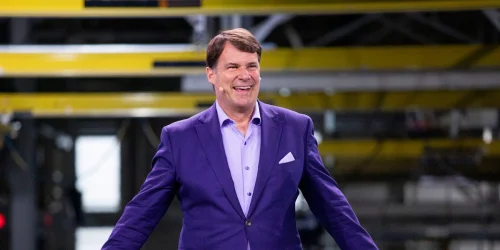
Imagine the CEO of one of America's most iconic car companies getting behind the wheel of a Chinese electric vehicle and not wanting to give it back. That's exactly what happened with Ford's Jim Farley, and his reason for choosing a Xiaomi over a Tesla reveals a seismic shift in the global auto industry that could hit closer to home than you think.
In a candid interview, Farley was asked why he spent six months testing the Xiaomi SU7 instead of a rival Tesla. His answer wasn't just about cars; it was a stark warning. "Nothing against Tesla — they've been doing great — but they really don't have an updated vehicle," he stated, pointing the spotlight squarely at a new, formidable force.
The "Best in the Business" Isn't Who You Think
For Farley, the real benchmark for competition isn't in California, but in China. He called brands like BYD the **"best in the business,"** praising their unmatched cost competitiveness, supply chain mastery, and manufacturing expertise. This isn't casual praise; it's a battle cry from inside the fortress of American manufacturing.
"Now, if we're smart, we'll take the cost competitiveness of BYD and then compete with that platform," Farley explained, outlining Ford's survival strategy. The next wave of customers, he says, wants electric pickups and SUVs—but they want them for **$30,000, not $50,000.**
A "Devastating" Threat to the Heart of America
This isn't the first time Farley has sounded the alarm. He's previously warned that the arrival of Chinese cars in the US would be **"devastating"** to the country's manufacturing base, which he calls its "heart and soul." His choice to drive a Xiaomi is a hands-on reconnaissance mission into what he clearly views as an existential threat.
This fear is already shaping Ford's future. The company has pivoted billions in investment away from pure electric models like the F-150 Lightning to focus on more affordable, hybrid vehicles. Their cheapest hybrid, the Maverick, starts at around **$28,000**—a direct move to build a financial moat against the coming competition.
The message is clear: the race for the future of driving is no longer a two-horse race between traditional US automakers and Tesla. A powerful third player has emerged from the East, and its greatest weapon is a price tag that could redefine what the world expects from an electric car. For American drivers, this fierce competition might finally bring affordable EVs. For American industry, the fight for survival has just begun.