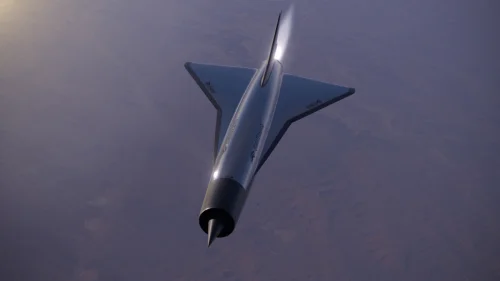
Los Angeles-based defence technology startup Hermeus has raised $350 million in a new funding round, pushing its valuation to $1 billion. The company, which is developing autonomous hypersonic aircraft, secured $200 million in equity financing led by Khosla Ventures, with participation from existing investors including Canaan Partners, Founders Fund, In-Q-Tel, and RTX Ventures. A further $150 million was raised as debt financing.
Hermeus co-founder and CEO AJ Piplica stated the debt component was strategic, allowing the company to finance hardware development and manufacturing expansion "non-dilutively." The funding arrives during a surge in venture capital investment into defence tech, which surpassed $9 billion across 265 rounds globally last year, according to data from PitchBook.
Strategic Pivot to Proven Engine Technology
A key factor in the fundraising success, according to company leadership, was a strategic technical pivot. Hermeus initially developed its own engine but later decided to partner with RTX Corporation subsidiary Pratt & Whitney to modify its existing F100 engine. This shift provides Hermeus with a proven powerplant for its aircraft, accelerating development.
"This accelerates us to Mach 5, and also reinforces the economics of the business while satisfying near term demand from the Department of Defence," said Hermeus president Zach Shore. The move allows the company to pursue multiple development paths concurrently, maturing its technology while securing government contracts.
Rapid Prototyping and Talent Challenge
Hermeus is employing a rapid prototyping strategy, uncommon in traditional aviation. Last month, it flew a full-scale demonstrator aircraft the size of an F-16 fighter jet. The startup aims to make the next iteration supersonic, with a third aircraft already in development.
Piplica cited SpaceX's iterative "build, test, fail, learn" model as an inspiration but identified talent cultivation as the company's hardest challenge. "There’s nowhere in the world where companies are building new full-scale aircraft on an annual basis... People used to do that, but they’re all dead, which means you have to go make those people," he said. The new capital will support staff growth beyond its current nearly 300 employees.
Embracing Risk in Development
Despite two successful test flights—including one last year with a smaller demonstrator—Piplica acknowledges that failure is an expected part of the rapid development process. "We could crash an airplane, and I expect it’ll happen at some point in our development program," he said, emphasising the importance of building multiple aircraft to maintain momentum and learn quickly.
The funding solidifies Hermeus's position in the competitive defence tech sector, enabling it to continue its ambitious timeline towards creating operational hypersonic unmanned aircraft for U.S. defence applications.