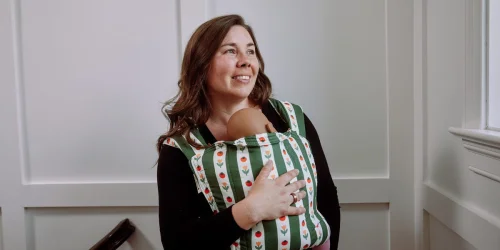
Imagine loving something so much, yet being told by an entire industry that it wasn't made for you. That was the daily reality for Skye Amundsen and her friend Mallory Mascoli. As plus-size mothers passionate about babywearing, they faced a market with painfully few comfortable options. Their frustration, shared in a simple text message, sparked a revolution that would defy every conventional business rule.
What began as a 2018 passion project is now hope&plum, a seven-figure brand supporting its founders and over 30 employees. The staggering growth—a 2,200% revenue surge between 2022 and 2025—is a masterclass in community-driven success. This is the story of how solving your own problem can unlock a market everyone else ignored.
The Unconventional Marketing That Built a Tribe
Forget expensive ad campaigns. hope&plum’s first customers came from a 300-member mum group on Facebook. Growth was organic, fuelled by the tight-knit, word-of-mouth babywearing community. They didn't just sell products; they built relationships, even cold-messaging large influencers to foster genuine connections rather than transactional deals.
Their social media strategy boldly rejected the era of perfectly curated Instagram feeds. Instead, Mallory and Skye posted content covered in breast milk, openly discussed miscarriages, and shared the raw challenges of being working mothers. This radical authenticity wasn't just branding—it was the core of their trust-building engine, making customers see themselves in the founders.
The Pivot That Ignited Explosive Growth
Initially, the duo were purists, advocating against mainstream buckle carriers. But their community kept asking for one. This forced a pivotal question: why were they resisting? The answer brought them full circle to their original pain point: as larger-bodied people, they had never found a comfortable buckle option.
Spending a year developing a better solution paid off spectacularly. Launching their buckle carrier in November 2023, the first run sold out in two days. A newborn version released in February 2024 sold out in under 24 hours, repeatedly selling out since and generating waitlists that fuelled each restock. The demand was undeniable.
The Hidden Struggle Behind the Seven-Figure Success
While sell-outs signal demand, they also create a scaling nightmare, especially for a company committed to ethical manufacturing. "You can't just magically make more product the next day," Skye admits, highlighting the constant battle of forecasting. The business, entirely bootstrapped from a £7,000 initial investment, has seen bank accounts dwindle to $10.
Profit took three years, and growth has meant relentless reinvestment, including a current half-million-pound warehouse renovation. After four years of doubling in size annually, Skye is now seeking something counterintuitive for a founder: slower, steadier growth to ensure sustainability for their team.
The hope&plum journey proves that the most powerful marketing isn't bought—it's built through genuine community, unwavering authenticity, and the courage to solve the problem no one else will.