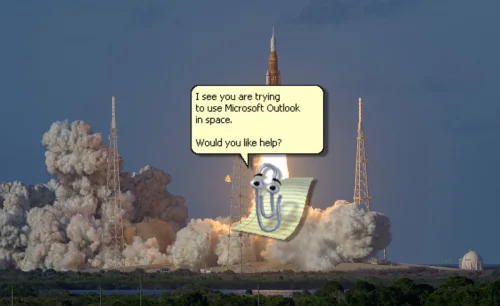
NASA's Artemis II moon mission, the first crewed lunar flight in fifty years, faced unexpected technical challenges shortly after its Wednesday launch. Commander Reid Wiseman reported issues with Microsoft Outlook running on his personal computing device aboard the Orion spacecraft, requiring remote support from Mission Control in Houston, Texas.
The crew also encountered a malfunction with the spacecraft's toilet fan, which ground teams subsequently resolved. These incidents occurred during the initial phase of the 10-day mission, which aims to circumnavigate the Moon with astronauts Wiseman, Victor Glover, Christina Koch, and Jeremy Hansen.
Software Glitch in Deep Space
During livestreamed communications, Commander Reid Wiseman informed Mission Control that two instances of Microsoft Outlook were running on his Microsoft Surface Pro tablet, designated as a Personal Computing Device (PCD). "I also see that I have two Microsoft Outlooks, and neither one of those are working," Wiseman stated, requesting remote access for troubleshooting.
Mission Control personnel successfully accessed PCD 1, resolving an initial issue with Optimus software and opening Outlook, though it remained in an expected offline mode. The incident highlights the integration of commercial, off-the-shelf technology like the Surface Pro in advanced spaceflight operations.
Concurrent Waste Management Problem
Separately, a fault was reported with the toilet ventilation system. NASA spokesperson Gary Jordan confirmed, "The toilet fan is reported to be jammed," noting that teams developed procedures to clear the obstruction. The crew had access to backup waste management capabilities during the repair process.
This is not the first time waste systems have posed challenges in space; similar issues have occurred on the International Space Station, underscoring the complexity of life support systems in microgravity.
Historical Context and Mission Objectives
The Artemis II mission follows the uncrewed Artemis I test flight and represents a critical step toward returning humans to the lunar surface. The mission has previously overcome significant pre-launch hurdles, including hydrogen and helium leaks and concerns about the spacecraft's heat shield.
NASA's approach involves using this mission to validate spacecraft systems, life support, and communication capabilities with crew aboard before attempting a lunar landing on Artemis III.
Next Steps and Communication
With the initial technical issues resolved, the four astronauts continue their journey toward the Moon. The mission remains on schedule for its lunar flyby, a manoeuvre last performed by humans during Apollo 17 in 1972.
Neither NASA nor Microsoft provided official comment on the software incident when contacted by TechCrunch. The mission continues to be streamed live, with further tests and operations planned for the coming days.