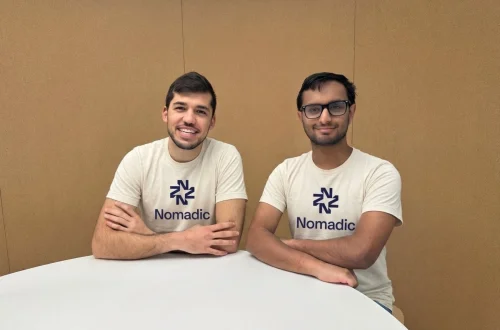
Nomadic AI, a startup founded by CEO Mustafa Bal and CTO Varun Krishnan, has secured $8.4 million in seed funding to tackle the immense data challenge facing autonomous vehicle (AV) and robotics companies. The round, led by TQ Ventures with participation from Pear VC and Google's Chief Scientist Jeff Dean, values the company at $50 million post-money.
The core problem Nomadic addresses is the inefficient management of video data. Companies developing self-driving cars and other autonomous systems collect millions of hours of footage for evaluation and training, but organising and cataloguing this data currently relies on manual human review. Nomadic's platform uses a collection of vision language models to automatically transform this raw footage into structured, searchable datasets.
From Data Archives to Actionable Insights
"We are providing folks insight on their own footage, whatever drives their own AVs [and] robots," CEO Mustafa Bal told TechCrunch. "That is what moves these autonomous systems builders forward, not random data." The platform allows developers to quickly identify specific, rare events—known as edge cases—which are crucial for refining AI models. For example, it can isolate instances where a vehicle should run a red light if directed by a police officer, or every time a vehicle passes under a specific type of bridge.
This capability serves a dual purpose: ensuring operational compliance and feeding directly into training pipelines to improve machine performance. The company has already onboarded customers including Zoox, Mitsubishi Electric, Natix Network, and radar technology firm Zendar.
More Than Just a Labelling Tool
While established data labelling firms like Scale AI and Kognic are developing similar AI tools, and Nvidia has released open-source models for the task, Nomadic positions its technology differently. CTO Varun Krishnan describes it as an "agentic reasoning system: you describe what it needs and it figures out how to find it," using multiple models to understand actions and context within videos.
Antonio Puglielli, VP of Engineering at customer Zendar, stated that Nomadic's tool allowed for faster scaling compared to outsourcing and praised its domain expertise. The startup's technical pedigree is notable; all of its roughly dozen engineers have published scientific papers, and Krishnan is an internationally ranked chess master.
Funding for Future Challenges
The new capital will be used to onboard more customers and refine the platform. Current development focuses on creating specialised tools, such as one that understands the physics of lane changes from camera footage. The next significant challenge, according to the company, is extending this capability to non-visual data like lidar sensor readings and integrating data from multiple sensor modes.
Schuster Tanger, a partner at lead investor TQ Ventures, justified the investment by comparing Nomadic to essential infrastructure. "The second an autonomous vehicle company tries to build Nomadic internally, they’re distracted from what makes them win, which is the robot itself," he told TechCrunch. The startup also recently won first prize at Nvidia's GTC pitch contest.