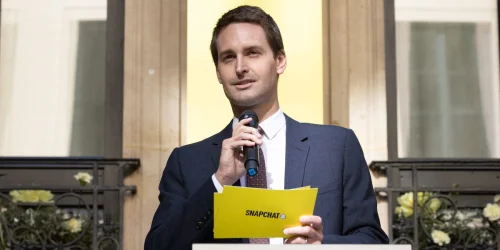
Snap Inc. will cut approximately 1,000 jobs as part of a strategic shift towards organising employees into small, AI-powered "squads," CEO Evan Spiegel announced on Wednesday. The move highlights a growing trend among major corporations to leverage artificial intelligence to create highly productive, leaner teams, a strategy often cited alongside workforce reductions.
Leaders at several prominent firms have recently made similar remarks. "It would be disingenuous to pretend AI doesn't change the mix of skills we need or the number of roles required in certain areas. It does," stated Mike Cannon-Brookes, CEO of software company Atlassian, in a securities filing last month announcing plans to cut 1,600 jobs.
Big Tech Embraces the Lean Model
Meta chief Mark Zuckerberg told analysts on a January earnings call that "we're starting to see projects that used to require big teams now be accomplished by a single very talented person." The philosophy extends beyond technology firms, with JPMorgan Chase CEO Jamie Dimon writing in his annual shareholder letter this month that "the real competitive battles" are fought by small, focused teams.
Proponents argue AI enables a few workers, or even individuals, to perform tasks that once required large groups. OpenAI CEO Sam Altman predicted in February 2024 that "we're going to see 10-person companies with billion-dollar valuations pretty soon."
Flatter Hierarchies and Potential Pitfalls
This shift towards tiny teams is frequently accompanied by a move away from middle management. Earlier this month, Block CEO Jack Dorsey described his "most ideal" structure as one where all 6,000 employees report directly to him, while Amazon's Andy Jassy said flattening the tech giant's hierarchy has improved its speed.
However, experts warn of significant risks. Matt Poepsel, Vice President of Talent Optimization at HR software firm The Predictive Index, cautioned that workers relying solely on AI for decision-making might amplify personal biases, calling the technology a "silicon sycophant" wired to encourage its own use.
Alex Lovell, a political psychologist at employee-recognition software company O.C. Tanner, noted that diminishing team sizes can hurt morale and business outcomes by reducing crucial colleague interaction, causing "inspiration to decay."
Long-Term Talent Pipeline Concerns
Further structural concerns involve corporate talent development. Soumitra Shukla, a research fellow at Harvard Business School and The Burning Glass Institute, warned that cutting entry-level roles can create future shortages of experienced workers. "You don't have as many people to promote to seniors," he said, adding that junior professionals may question their career progression in companies embracing ultra-lean models.
According to Stanford University economics professor Erik Brynjolfsson, success will not simply belong to the leanest organisations. "They'll be the ones that best redesign work so humans and AI complement each other," he said.