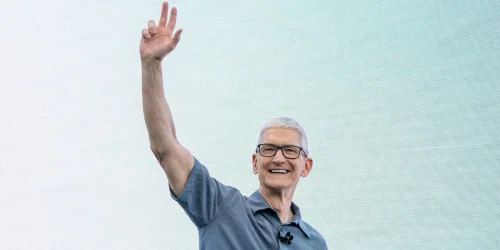
For 15 years, he was the quiet man steering the world's most valuable company. But as Tim Cook prepares to hand over the CEO title at Apple this September, a fierce battle is raging behind the scenes. What is his *true* legacy? Was he a visionary leader or just a brilliant operations manager? The answers are more divisive—and more revealing about Apple's future—than you think.
Cook took the helm in 2011, facing genuine doubts about whether he could ever fill Steve Jobs's shoes. Today, the numbers speak for themselves: a stock price that soared over **2,000%** and the company's historic rise to a trillion-dollar valuation. But the real story isn't in the spreadsheets. It's in the passionate, and sometimes brutal, verdicts from the smartest people in tech.
Legend or Librarian? The Industry's Explosive Verdict
Sam Altman, the CEO of OpenAI, didn't mince words. "Tim Cook is a legend," he declared. Yet, this praise is just one side of a heated argument. Others see a different picture entirely.
"His job was not only to grow Apple after Steve Jobs," argues Ben Bajarin of Creative Strategies. "It was to preserve as much of Apple's core identity... while leading it through a vastly different era." For some, this makes Cook the guardian of the company's soul. For his critics, it makes him a caretaker, not a creator.
The "Innovation" Myth: What Cook Actually Built
You've likely heard the damning critique: "Tim Cook didn't innovate!" Tech commentator Joseph Carlson fires back with a formidable list: the Apple Watch, AirPods, Apple Pay, and Face ID all launched under Cook's watch. "Don't come at me with this idiotic take," he writes.
But Andrés Avila Páez of Arturito AI pinpoints Cook's genius elsewhere. "Steve Jobs had the idea and created the iPhone. Tim Cook imagined and designed something even more difficult: **the machine that manufactures it 200 million times a year without failing.**" This, he says, is a legacy of "pure operational engineering."
The Shadow Over the Legacy: Cook's Political Dance
Not all commentary is about products and profits. Robert Reich, former US Secretary of Labor, casts a stark shadow. He urges people to remember Cook's **$1 million contribution to Trump's inauguration** and how he "fawned over Trump" while Apple lobbied for tariff exemptions. It's a controversial footnote that complicates the polished corporate narrative.
What Happens Now? The Risky Bet on a New CEO
So, what does Apple get with its new leader, hardware chief John Ternus? Analysts like Patrick Moorhead call him a "continuity candidate," not a "risk-taking visionary." The expectation is "tight operational execution" and "incremental product iteration."
But for fans and investors craving bold moves, this is worrying. Tech enthusiast Sawyer Merritt hopes Ternus, as an engineer, can help Apple catch up on AI. "I think that is what Apple needs at this stage," he says, hinting that the era of safe, steady growth might be over.
Cook's tenure turned countless ordinary investors into millionaires and built a logistical empire of unimaginable scale. Yet, as he exits, Apple stands at a crossroads between its meticulously managed past and a future demanding radical innovation. The debate over his legacy isn't just about history—it's the key to understanding what the tech giant becomes next.