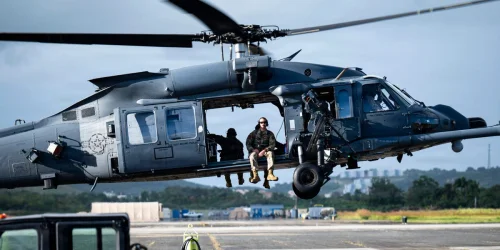
US Air Force combat search-and-rescue (CSAR) crews conducted a high-risk daylight operation to retrieve a downed F-15E Strike Eagle crew member after the fighter jet was reportedly lost to enemy fire over Iran. A second crew member's status remains unclear. The mission, described by a serving CSAR pilot as extraordinarily bold and "terrifying," saw two rescue helicopters struck by hostile fire but able to return to base.
US Central Command has not publicly commented on the incidents reported by multiple American media outlets on Friday. The operations underscore the inherent dangers of CSAR missions, which are a sacred duty for US forces aimed at preventing personnel from falling into enemy hands.
‘Complete other level’ of risk
The CSAR pilot, who spoke to Business Insider on condition of anonymity, stated that such missions are dangerous even under optimal conditions—ideally on "darkest of dark nights." Conducting a rescue in broad daylight, exposing slow-moving helicopters to enemy observation, represented a "complete other level" of risk, reflecting the urgent priority of recovering American personnel. "It is sort of terrifying to go like, 'let's just go fly in broad daylight into the middle of a country that is at war with us,'" he said.
Anatomy of a modern rescue mission
Modern CSAR is a well-resourced and practised capability within the US Air Force, involving units from Air Combat Command and Air Force Special Operations Command. A typical mission package includes HH-60G Pave Hawk helicopters for the search and recovery, HC-130 aircraft for aerial refueling, and Pararescue Jumpers (PJs)—specially trained medics—to secure casualties.
These assets are often supported by a command-and-control aircraft, such as an A-10 Thunderbolt II, which can coordinate the rescue and provide defensive cover. The helicopter crews, flying low and slow to locate personnel, are vulnerable to threats ranging from small arms to surface-to-air missiles.
Historical legacy and critical duty
Combat search-and-rescue operations were significantly expanded and refined during the Vietnam War, when numerous US aircrews were shot down and captured. The mission's importance is deeply ingrained; all aircrew train for the possibility of being downed behind enemy lines through SERE (Survive, Evade, Resist, Escape) training.
"Finding crews before the enemy does is critical," the pilot explained, noting that capture can have serious strategic consequences beyond the fate of the individual service member. The helicopters used today share the "Jolly Green" nickname with their Vietnam-era predecessors.
Training for the worst-case scenario
Despite the advanced training and resources, the fundamental challenge remains perilous. Crews must be prepared to operate in any environment, from open desert to complex urban terrain with hidden obstacles like power lines. "You train a whole lot, and the hope is you never have to do it," the CSAR pilot said. "But you certainly train to do it every single day."