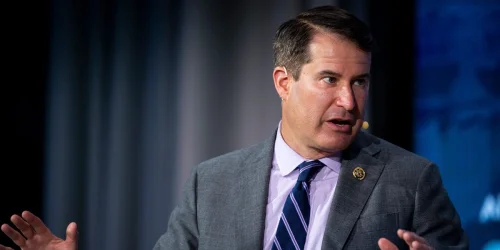
A growing number of US lawmakers are moving to prohibit their congressional staff from participating in political prediction markets, citing ethical concerns over potential insider trading. The issue has gained traction following a public announcement by Democratic Representative Seth Moulton of Massachusetts, who instituted an office-wide ban effective immediately.
Moulton told Business Insider he has received significant bipartisan support for his decision, with colleagues from both parties approaching him to express agreement. "I've never put something out and had more immediate response from a bipartisan group of members than this," Moulton stated. "People on both sides of the aisle recognize this is credibly corrupt, and we need to take action to stop it."
Legislative Proposals Emerge
In response to broader concerns in Washington, a series of legislative bills have been introduced aiming to regulate the prediction market industry. The proposals vary in scope, from measures targeting insider trading to broader industry restrictions. Democratic Representative Alexandria Ocasio-Cortez of New York has likened the industry to "Big Tobacco," indicating support for stringent regulation.
Ocasio-Cortez noted that while her current office policies likely already prohibit such trading, "it doesn't hurt to really refine the letter on it." However, none of these legislative proposals are currently close to becoming law, particularly as the Trump administration maintains a friendly stance toward the industry.
White House Issues Warning
Concerns have been particularly focused on the White House, following well-timed trades around recent actions in Iran and Venezuela. In March, the administration warned White House staffers against making prediction market trades. White House spokesman Davis Ingle reiterated that "All federal employees are subject to government ethics guidelines that prohibit the use of nonpublic information for financial benefit."
The administration has denied that any staff are profiting from such trades.
Potential for Insider Advantage
There is no hard evidence of widespread prediction market trading among Capitol Hill staff. However, theoretical avenues for profiting from non-public information exist, such as markets betting on the likelihood or duration of government shutdowns, or on a lawmaker's public statements.
Democratic Senator Chris Murphy of Connecticut confirmed the issue is under internal discussion, stating, "It's something we've talked about internally. We haven't put out any official guidance, but you know, that certainly seems like it would make sense."
Diverging Approaches Among Lawmakers
Not all lawmakers see an immediate need for formal office bans. Democratic Representative Greg Casar of Texas, who sponsors a bill to ban prediction markets vulnerable to insider trading, indicated his staff would not consider participating. "If I go and put a policy in, or not, I don't think it makes any difference, because they just don't do it," Casar said.
Other legislators, like Democratic Senator Jeff Merkley of Oregon, believe action should start at the top. Merkley, who introduced a bill to ban lawmakers themselves from trading, said, "I think it'd be very powerful for Congress to start with the people who are at the top of the food chain, which is the members themselves."
Focus on Disclosure and Future Steps
Republican Senator Todd Young of Indiana has introduced a bill requiring lawmakers and staff to disclose their prediction market trades, calling the idea "appropriate, at least for starters." He added, "I'd be open to other good government reforms," indicating the debate on the appropriate level of restriction is ongoing.
In the absence of comprehensive legislation, the enforcement of ethics rules currently falls to individual lawmakers within their own offices, leading to a patchwork of policies as the congressional scrutiny of prediction markets intensifies.