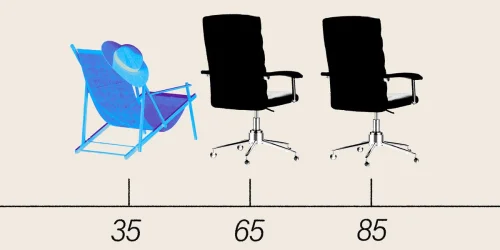
The traditional path of retiring at 65 is eroding in the United States, with a growing number of Americans working into their 80s and others aiming for financial independence in their 30s and 40s. This shift is driven by economic necessity, longer lifespans, and a fundamental re-evaluation of work's purpose in life.
Data shows the 75-and-older workforce is the fastest-growing demographic, with 4.2% of the over-80 population still employed, up from 3% in 2010. Conversely, a 2023 survey found a quarter of respondents wanted to retire before turning 50, part of the growing FIRE (Financial Independence, Retire Early) movement.
The Reality for America's Oldest Workers
For many older Americans, continuing to work is not a choice but a financial imperative. Brian Burdick, 82, a school bus driver in Wichita, Kansas, saw his savings depleted by a series of personal crises. "I became a school bus driver and worked evenings at a department store to 'just survive,'" he says. His current $28-an-hour wage, combined with Social Security, provides stability, but work now also offers profound personal value. "I've taught autistic kids to talk... I have an excuse to get out of bed," Burdick explains.
Others, like Vicki Vosper-Fenton, 81, work by choice for fulfilment. After a career in counselling, she now juggles jobs as an online teacher and a genealogist in Idaho. "Serving others in whatever capacity just simply brings joy to my life and keeps me young," she says, adding she has "decided to mentally be 55."
The Pursuit of Early Financial Independence
On the opposite end of the spectrum, adherents of the FIRE movement are redefining retirement as financial freedom rather than complete inactivity. Amanda Walt, 33, a tech program manager in Boston with a seven-figure net worth, views "retirement [as] a full-funded lifestyle change." For her, it enables "intentional career breaks" that accelerate long-term growth.
Ewa Linn, 37, and her husband achieved FIRE in 2024 through aggressive saving, investing in index funds, and "house hacking." They now selectively accept freelance work. "We only say yes to clients who are enjoyable and projects that fulfill us," Linn states. Similarly, Meg Nichols, 31, has taken multiple "mini retirements" and, as a "Coast FI" adherent, chooses roles based on interest, not just compensation.
Experts See a Redefinition of Work
Labour experts observe a generational difference in how work is perceived. Robert Bruno, director of the Labor Education Program at the University of Illinois Urbana-Champaign, notes that younger workers often seek a clearer work-life balance, while older workers have traditionally "accepted what the hours were."
Grant Sabatier, author of "Financial Freedom," argues the traditional career grind stifles personal growth. He says the FIRE movement has internalised the regrets of older generations who wished they had "spent more time with family, or... traveled more."
The Future of Retirement
The growing extremes of working late and retiring early challenge the viability of the mid-60s retirement benchmark. Economists debate raising the official retirement age or indexing it to life expectancy, while others advocate for earlier benefits for vulnerable groups.
For individuals on both sides of the shift, 65 is increasingly seen as an arbitrary number. The consensus among those interviewed is that finding purpose—whether through continued work or early financial freedom—is the key to a fulfilling life, rendering the old retirement model obsolete.