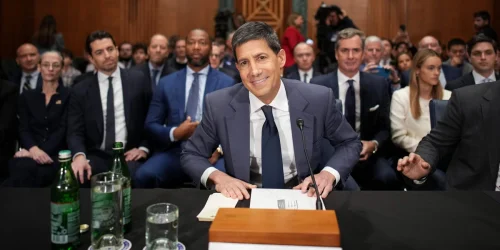
Imagine the person in charge of America's entire economy, your mortgage rates, and your job security. Now imagine they have a personal fortune of more than $100 million tied up in investments they won't fully disclose. That's the explosive reality facing Kevin Warsh, Donald Trump's controversial pick to lead the Federal Reserve.
In a tense Senate hearing that laid bare a deep political divide, Warsh faced a barrage of questions not just about interest rates, but about his very soul. The core question hanging in the air: Is this nominee a fiercely independent guardian of the economy, or a "sock puppet" for a president who has openly attacked the Fed's autonomy?
"You're Going To Be An Unsuccessful Chair": The Independence Ultimatum
Republican Senator Thom Tillis delivered a stark warning that cuts to the heart of the drama. "If anybody thinks the president can appoint somebody and you unilaterally can control things, you're going to be an unsuccessful chair," he told Warsh. His support hinges on Trump dropping a highly unusual criminal investigation into the current chair, Jerome Powell—a probe Tillis called the work of "some US attorney with a dream."
This isn't just political theatre. It's a direct threat to the bedrock principle of Fed independence, which exists to stop politicians from manipulating the economy for short-term gain. Warsh assured senators he believes independence is "essential," but his words are being picked apart by experts watching every syllable.
The $100 Million Elephant in the Room
While Republicans wrestle with questions of power, Democrats are zeroing in on money. Senator Elizabeth Warren launched a brutal attack, repeatedly labelling Warsh a "sock puppet" for Trump and highlighting his refusal to disclose over $100 million in investments to ethics officials.
"The Fed has been plagued by deeply disturbing ethics scandals in recent years," Warren stated, arguing the next chair must have "no financial conflicts." Warsh promised to divest from conflicts before taking office, but the damage to his credibility was done. Top economist Justin Wolfers put it bluntly on X: "If you can't state simple facts when you're in the political spotlight, you aren't independent. You're a coward."
Will He Cut Rates for Trump? What the Experts Really Fear
Beyond the political firefight, economists are dissecting what a Warsh Fed would mean for your wallet. Known as a "hawk" who prioritises fighting inflation, his stance seems at odds with Trump's public desire for rate cuts. So, who wins?
Nobel laureate Paul Krugman is sceptical, warning that "technocrats at the Federal Reserve will not actually deliver the rate cuts Trump wants." Yet, Allianz's Mohamed El-Erian predicts Warsh may "err on the side of lowering rates earlier." The contradiction highlights the impossible tightrope he walks: pleasing Republican senators, calming Wall Street, and getting Trump to end the probe against Powell, all at once.
Former Fed economist Claudia Sahm pinpointed the core tension: if Warsh believes, as he told senators, that "true inflation" is a long-term issue, why isn't he calling for higher rates now? It's a question that exposes the gap between economic theory and political reality.
A Fundamental Shift Is Coming to Your Bank Account
Forget the political noise for a moment. The real story is what Warsh has spent a decade advocating: a radically smaller Fed. As Hoover Institution economist John Cochrane explains, Warsh wants the Fed to "buy less government bonds, shrink its footprint on markets... and do less overall."
This isn't a minor tweak. It's a philosophical revolution that would mean less intervention in markets, potentially leading to more volatility in everything from your pension fund to business loans. It’s a future where the central bank's hand on the economic wheel is much, much lighter.
The battle over Kevin Warsh is about more than one job. It's a proxy war for the soul of the American economy. Will it remain guided by independent data, or by the whims of political power? The answer will define financial stability for a generation, and the Senate's decision will send shockwaves from Wall Street straight to your high street.